
How to Buy Thinking Time in IELTS Speaking Part 3
Part 3 gives you no preparation minute. A working method for IELTS Speaking Part 3 sample answers: open with a framing sentence that names the shape of the question, then answer it - with the exact wording for cause, comparison and prediction questions, two full worked answers, and the trap of letting the frame eat the answer.


On this page
Part 3 begins without a preparation minute. The examiner moves from your cue card into a general discussion of the same topic, and the first question usually asks you to explain, compare or predict something you have never considered. IELTS.org describes Part 3 as a four-to-five-minute general discussion and points out that there is no preparation time beforehand, which is exactly why candidates freeze on the opening question rather than halfway through the answer.
Most IELTS Speaking Part 3 sample answers hide the problem they are supposed to solve. They are printed as finished prose, so the pause that produced the first sentence has been edited out. This guide puts the pause back. It maps the abstract question shapes you will actually hear onto a two-part answer move, gives the exact wording of the framing sentence that opens each shape, and walks through two complete answers so you can see where that sentence sits and what it has to do.
What the marking actually penalises
The IELTS Speaking band descriptors are unusually specific about hesitation. At band 9, hesitation is described as being used only to prepare the content of the next utterance and not to find words or grammar. At band 8, hesitating to find words is allowed occasionally, but most hesitation should be content related. Band 7 tolerates hesitation that signals a problem accessing language, provided coherence survives.
Read those three bands together and the target becomes clear. Nobody is asking you to remove the pause after an abstract question. You are being asked to make the pause look like thinking about content rather than searching for language, because that is the difference the fluency criterion is written around. The source is the public Speaking Band Descriptors published by IELTS.org.
That distinction explains why That is a good question. fails where a framing sentence succeeds. Both buy a second. Only one of them spends that second on content.
The two-part answer move
Part one is a framing sentence: one sentence that names the shape of the question, takes a provisional position, and promises the structure of what follows. Part two is the answer move: the position, one reason, one concrete detail.
The framing sentence is not a filler with better manners. It is the first half of the answer, which is why the thinking time it buys is not lost. Compare the two openings below:
That is a good question.buys a second, says nothing, and announces that the answer has not started.Off the top of my head, I would put it down to two things.buys the same second, tells the examiner the shape of what is coming, and commits you to a structure you can now fill.
Three rules keep a frame honest. It must contain a position, even a provisional one. It must promise something you can deliver in the next thirty seconds. And it must be one sentence, because a second sentence is where framing turns into stalling.
Three shapes and the wording that fits each
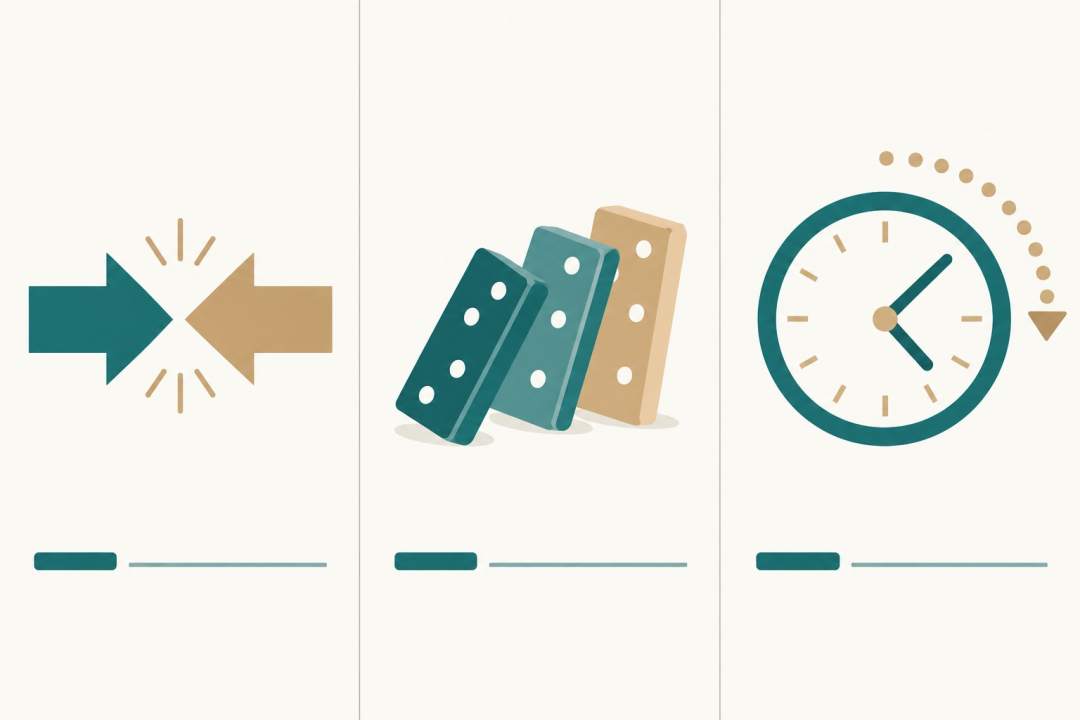
Abstract questions are not unlimited in shape. Three of them cover most of what you will hear in a Part 3 discussion, and each has wording that fits it.
| Shape | What the examiner is asking for | Framing sentence | What must follow |
|---|---|---|---|
| Cause | One or two reasons, with a mechanism | Off the top of my head, I would put it down to two things. | The two things, named, then one of them developed |
| Comparison | The axis on which two groups differ | Honestly, I do not think they are as different as they look. | The axis, then one side of it in detail |
| Prediction | One trend and what drives it | I would not want to put a date on it, but the direction seems clear. | The trend, then the driver, then one consequence |
Cause questions: explaining why something happens
A cause question sounds like Why do some people prefer to live alone in large cities?. The trap is answering with a list of nouns. The frame promises a number, so the answer has a shape before you know what will fill it:
Off the top of my head, I would put it down to two things.I think there are two reasons, and the second one matters more.
The second version is stronger when you already sense which reason you can develop, because it tells the examiner a hierarchy is coming and makes the following sentences easier to follow.
Comparison questions: putting two groups side by side
A comparison question sounds like Do younger and older people use public libraries in the same way?. The frame's job is to choose the axis before you have examples:
Honestly, I do not think they are as different as they look.They overlap more than people assume, but they start from different places.
Both frames refuse the yes-or-no shape of the question, which is what a discussion question wants. What follows has to name the axis: how often they go, why they go, or what they do while they are there. Pick one and stay on it.
Prediction questions: saying how something will change
A prediction question sounds like How do you think the way people work will change in the next twenty years?. Prediction is the shape that produces the longest silence, because the honest answer is that nobody knows. The frame converts not knowing into a position:
I would not want to put a date on it, but the direction seems clear.My guess is that the change will be slower than people expect.
The first frame buys time by refusing only the detail nobody can supply. The second buys time by disagreeing with the obvious answer, which is a position the examiner can follow.
Two worked answers, with the frame in place
Both answers below are constructed to show the move; they are not transcripts from a named candidate. Read the first line of each as the framing sentence, then watch what the rest of the answer does with the promise it made.
Worked answer one: a cause question
The question: Why do some people prefer to live alone in large cities?
Off the top of my head, I would put it down to two things: money and time. A single flat is within reach for people who would have shared a house a generation ago, because rents in the outer districts stayed flat while wages crept up. The bigger reason is time. If you finish work at eight, cooking and cleaning for other people is the first thing you drop, and living alone removes the argument about whose turn it is. So it is less about wanting solitude than about buying back an evening.
| Line | What it is doing | What it buys |
|---|---|---|
| 1 | Framing sentence: two causes promised, position taken | A second of thinking, plus a structure the rest of the answer fills |
| 2 | First cause with a mechanism | The detail that carries vocabulary, not just a label |
| 3 | Signal that the second cause matters more | Coherence: the examiner hears a hierarchy |
| 4 | Second cause with a scene the listener can picture | The example, at the length the answer can afford |
| 5 | Closing contrast that narrows the claim | An ending, instead of a fade-out |
Worked answer two: a prediction question
The question: How do you think the way people work will change in the next twenty years?
I would not want to put a date on it, but the direction seems clear to me. More work will be organised around tasks than around hours, so the nine-to-five will survive mainly in jobs that serve the public. The driver is not technology on its own; it is that companies have learned they can hire for a project and stop. That will make the first five years of a career harder, because the informal training that used to happen in an office disappears. I would not call it progress, but I do not think it is reversible either.
| Line | What it is doing | What it buys |
|---|---|---|
| 1 | Framing sentence: refuses the date, takes the direction | A second of thinking without sounding evasive |
| 2 | The trend, stated as a comparison of two ways of organising work | Range: two structures in one sentence |
| 3 | The driver, separated from the trend | Analysis, which is what a discussion question rewards |
| 4 | One consequence, made concrete | The detail that makes the prediction testable |
| 5 | A concession that keeps the claim honest | A close that does not overclaim |
Both answers run to roughly forty seconds at a conversational pace, which leaves room for the examiner's follow-up. That follow-up is where a frame that promised too much becomes visible: if you said two things and delivered one, the next question will find the gap.
The trap: when the framing eats the answer
A frame is a tool with a sharp edge. Three symptoms show that it has taken over:
- the stacked frame:
Well, that is an interesting question. I suppose, in a way, it depends.Two frames, no position, four seconds gone. - the empty frame:
That is quite a difficult thing to talk about.It announces difficulty and promises nothing. - the restatement frame:
So you are asking whether young and old people use libraries differently.It repeats the question in your own words, which the examiner can already hear.

Each symptom costs the same thing. The answer move is where the reason, the detail and the closing contrast live, and the descriptors reward topic development, which only happens after the frame. Every second spent before the answer move is a second not spent developing anything.
The repair is mechanical. One sentence, first clause only. If you hear yourself starting a second frame, cut it and begin the position: The bigger reason is time. is a better second sentence than Another thing I would say is that....
A drill you can run in ten minutes
- Choose one question from each of the three shapes and write only the framing sentence for each. No answers.
- Say each frame aloud, then stop. If it does not contain a position, rewrite it until it does.
- Answer one question in forty seconds and record it.
- Listen back once and mark the moment the answer move starts. If it starts after four seconds, the frame ran long.
- Move to the next shape. Keep the frames you actually used; delete the ones you wrote and never said.
What an app can check, and what its score cannot
The App Store listing for HiBay describes an IELTS mode with questions from Parts 1, 2 and 3, sample answers, scores, analysis and a polished version of your own answer. For this method the useful part is the comparison, not the number: you hear your own framing sentence next to a cleaner version of it, which is the only way to notice a frame that ran long.
What a practice score cannot tell you is whether the pause was content-bearing. A practice score is not an examiner's band, and it can move because you spoke faster, paused longer or used a different microphone. The recording answers the question the score cannot: did the position arrive before the detail, and was the frame one sentence.
If you want the follow-up question after every answer, run a Part 3 sequence in IELTS speaking practice with AI. If the cue card is the part that still feels unplanned, work through the Part 2 cue cards guide first, because a Part 2 you have planned leaves more attention for the abstract questions that follow.
Frequently Asked Questions
Do framing sentences work in Part 1 and Part 2 as well?
Partly. Part 1 questions are concrete, so a frame spends time you could spend on a second detail, and the honest version of a Part 1 answer is shorter. Part 2 comes with a preparation minute, so the frame belongs at the start of the long turn, where it can announce the structure you planned. The one or two rounding-off questions after the long turn behave like Part 3, and the cause, comparison and prediction frames work there unchanged.
Can a framing sentence sound memorised to the examiner?
It can, and the giveaway is repetition rather than the words themselves. A frame that arrives identically three times in one discussion sounds like a script; the same frame with a different noun, or with the position changed, sounds like a habit. Keep two frames per shape and vary the second clause to fit the question, since nothing in the band descriptors penalises preparation, while hesitation that searches for language is what the fluency criterion describes.