
IELTS Speaking Part 2: Describing an Object for the Full Two Minutes
An object frame for ielts speaking part 2 cue cards: what it is, how it arrived, what it replaced, and the notes that survive two minutes of talking.

On this page
People and places are easy to talk about for two minutes because something in them moves. An object does not move. The card says Describe something you own that you use every day, you write four words in the minute, and by the second sentence you are describing the colour again.
The problem is not vocabulary. It is that an object sits still, so nothing in it suggests the next sentence. The frame below solves that by treating ielts speaking part 2 cue cards as a set of relationships rather than a description: what the thing is, how it arrived, what it replaced, and what would change without it.
Why object cards empty out faster than any other card
A person card gives you history and habits. A place card gives you movement through space. An object card gives you features, and features run out in about forty seconds.
The turn is fixed: one minute to prepare, up to two minutes to speak, and the examiner may stop you at two. You are not required to use every bullet on the card, but you are required to keep going.
So the frame has to generate content, not organise it. Four lenses, each of which produces at least thirty seconds, is enough for two minutes even if you speak slowly.
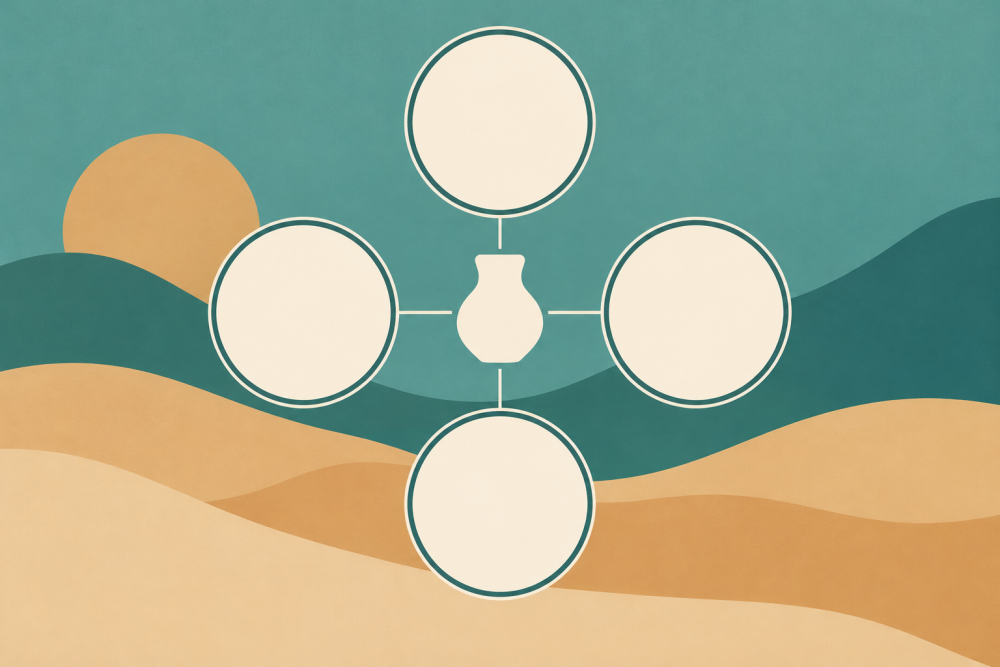
The four lenses that produce two minutes
Lens one: what it is and what it does. Not the brand, not the colour, but the job it performs in your day.
Lens two: how it arrived. Objects have origin stories, and origin stories have people, dates and small decisions in them.
Lens three: what it replaced. Almost every object you use daily displaced something else, and the comparison is where the interesting language lives.
Lens four: what would change without it. This is the lens that produces reflection, and reflection is what separates a band 6 answer from a band 7 one.
It's a cheap electric kettle. It boils water in about ninety seconds. I bought it in my second year because my flat had no kettle at all. Before that I boiled water in a pan, which took four minutes and ruined one pan a year. Without it I'd probably go back to the pan, and I'd drink less tea.
That is fifty seconds. Add one detail to each lens and it becomes ninety.
The one-minute note page
Six notes, not a script. On the card, write:
- What and what for
- Where it came from
- What it replaced
- One small problem with it
- What you would change
- One word for how you feel about it
The fourth note is the one most candidates skip and the one that buys the most time. A problem creates a story: it broke, you repaired it, you nearly replaced it.
Do not write sentences. A sentence on the page becomes a sentence you read aloud, and reading aloud sounds like reading aloud.
Twelve phrases that buy a second without sounding stuck
These are not fillers for their own sake; each one adds information while your next idea forms.
The reason I bought it was... What I didn't expect was... It's not expensive, but... The odd thing is... I've had it for about... Compared with the old one... If it broke tomorrow... I keep it because... The only problem is... It sounds trivial, but... What I actually use it for is... I'd replace it with the same thing...
Choose four. Twelve in a two-minute answer becomes a tic.
A full two-minute answer with the notes beside it
Notes: kettle / second year / replaced a pan / leaks slightly / would buy the same / oddly fond of it.
Answer: The object I'd describe is a kettle, which sounds boring, but it's the thing I use most in the day. It's a cheap electric one that holds about a litre, and it boils in ninety seconds, which matters when you're late. I bought it in my second year of university, from a shop near the station, because the flat I moved into had a hob and no kettle at all. Before that I boiled water in a pan, which took about four minutes and burnt the bottom of one pan a year, so the kettle was really a small upgrade in temper as much as in speed. The odd thing is that it leaks slightly at the base now, so I keep it on a saucer, and I've been meaning to replace it for about a year. If I did replace it, I'd buy the same model, because everything else I've tried is either too slow or too loud in the morning. I wouldn't say I'm attached to it, but I'd notice if it went.
That is about two minutes at a normal pace. Note that every paragraph of it comes from one note on the page.
Three object cards to rehearse with
Describe something you own that you use every day. Describe something you bought that was more useful than you expected. Describe something you keep even though you rarely use it.
For each, fill the six notes, then speak once with the page in front of you and once without. The second run is the one that counts, because the exam has no page.
Frequently asked questions
What objects come up in IELTS Speaking Part 2?
The common ones are a piece of clothing, a phone or device, a gift you were given, something you use at work, and something you bought that was expensive for you. All of them fit the four lenses, because all of them arrived at some point, replaced something, and could be lost. If the card names a category you have never owned, choose the nearest thing you have and say so in the first sentence: I don't own a car, but the thing I use most is my bike.
How many notes should I write in the minute?
Six short notes, one per lens plus a problem and a feeling. Writing more turns the minute into drafting and leaves no time to rehearse the opening sentence, which is the only part that has to be fluent. If you write fast, use the leftover seconds to say your first sentence silently, because the opening is where most candidates stall.