
How to Talk to Professors and Classmates in English
Talking to a professor in English gets easier when you plan three moments in advance: the email, the office-hours visit and the one sentence you contribute in class. This guide gives you the sentences to borrow, the timing that gets a reply, and the habits that make you sound vague, including how to talk to professors in English without over-apologising.


On this page
Most international students meet the same three awkward moments in their first semester abroad: the email you rewrite five times, the office-hours door you walk past, and the class discussion where your sentence disappears before you manage to say it. None of those is a grammar problem. They are audience problems, and the quickest fix is to prepare a few sentences before the situation arrives rather than during it.
This guide is a practical answer to how to talk to professors in English. It covers the first email, the office-hours visit, the classroom, the corridor and the group chat, with example sentences you can borrow and adjust. It also covers what not to do, because most of the awkwardness in academic English comes from habits rather than from a small vocabulary.
One rule runs through everything below: name the situation, keep the request short, and give the other person an easy way to answer. That is what makes a student sound reliable in English even when the grammar is not perfect.
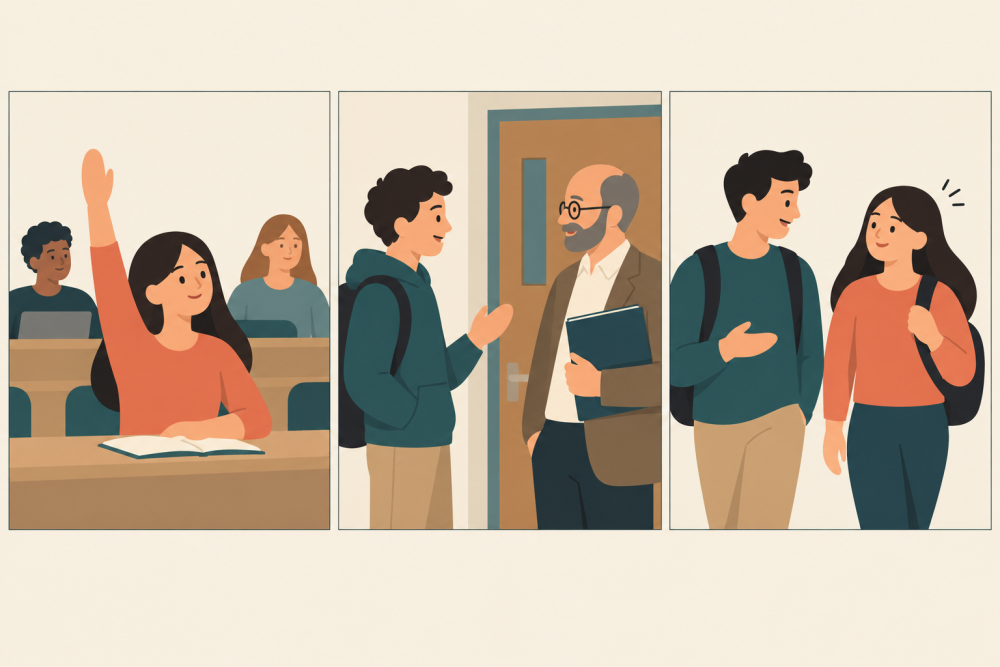
Prepare the Three Moments Before They Happen
The three moments that matter are the written request, the spoken request and the classroom contribution. You can rehearse all three in ten minutes with one notebook page.
The written request is your first email to a professor. Its job is not to be elegant; it is to be answerable. One line of context, one clear question, one proposed time, then your name.
The spoken request is the office-hours visit or the minute after the lecture. Its job is to show that you have read the material and to leave the professor with exactly one thing to answer.
The classroom contribution is the hardest of the three, because you cannot choose the timing. Prepare two sentence stems before the seminar, one to agree and add, one to disagree politely, and decide in advance that you will use whichever one you can say without thinking.
Write the First Email So It Can Be Answered
Open with the title and surname printed on your syllabus: Dear Professor Chen,. Then say who you are and which course you are in: I am in your Tuesday seminar on urban history. If you are asking for a meeting, propose a window instead of asking for "some time": Could we meet for ten minutes this week? and follow it with Would Thursday at 3 p.m. work for you? Close with Thank you for your time. and your full name as it appears on the class list.
Keep the message under a hundred words, and send the question that actually blocks you now: a long email asks the professor to do editorial work before answering, so it gets postponed.
Write the subject line as the course plus the topic, for example HIST 214 essay 2 question. That single line tells the reader which pile the message belongs to, and it is often what decides whether you get an answer today or next week.
What to Say at Office Hours
Arrive with the material open and start with the narrow question rather than the whole assignment: I have a question about the second essay question. Then say what you already tried, for example that you drafted an introduction but cannot see how to move from the outline into the first body paragraph.
If you did not understand the answer, ask again instead of nodding. Could you say that again, please? is not a confession of failure; it is an instruction to slow down, and every teacher hears it in every language. Check your understanding with a paraphrase: So you mean the argument should come in the first paragraph, not at the end?
The register expected in an academic setting is closer to business English speaking practice than to the way you text a friend: fewer fillers, more complete sentences, and a clear ending. You do not need to sound stiff, but you do need to be unambiguous about what you are asking for.
Before you leave, say the next step out loud: So I will narrow the introduction and send you one page by Friday. Professors remember the students who summarise the plan.
Speak Up in Class Without Freezing
Speaking in a seminar is a timing skill before it is a language skill. The first contribution of the term is the hardest, so make it short: I would like to add one point. You can write that sentence in the margin before class and still sound spontaneous when you use it.
When you disagree, separate the person from the claim: I see it slightly differently, because the data in chapter two seems to point elsewhere. The sentence is long enough to be polite and short enough to say without reading from a script.
Rehearsing out loud once is what makes this work, for the same reason that preparation helps in English job interview questions and answers: you are training retrieval, not memorising a text. Say your sentence in an empty corridor and then use it in class the same week.
If the discussion moves faster than you can follow, ask a process question rather than a content question: Could we go back to the point about the second reading? That buys you time, it is a normal thing to ask, and it keeps you inside the conversation instead of outside it.
Talk to Classmates Outside the Classroom
Classmates are easier to practise with than professors. Ask about the task, not about the person: Did you understand what we have to hand in for Thursday? or Do you want to work on the problem set together? Both questions are safe in the first week, when nobody has friends yet.
If you missed what someone said, say so straight away: Sorry, I did not catch that, could you repeat it? Waiting until you have lost three sentences costs more than one interruption.
Small talk about the course is safe ground and it builds the habit of speaking English in a low-stakes setting. Ask one question about the material at the end of each session; after two weeks you will have three or four people who greet you by name.
What Not to Do
Do not open with the request alone. A message that says only "please send me the slides" and carries no greeting, no course and no name reads as a demand, and it also fails the visibility test, because a professor with four hundred students cannot place you.
Do not apologise for your English at length. Sorry, my English is not good is a pre-emptive excuse that asks the professor to reassure you instead of answering you. Say the sentence you prepared, and if it comes out wrong, correct it in the next sentence.
Do not guess at a title. Use the one printed on the syllabus, and when you are unsure, Dear Professor plus the surname is the safer default in English-speaking universities.
Do not disappear after a missed deadline. Send a short message before the deadline, not after it: I was ill last week and I am behind on the second essay. May I submit it on Monday? Most academic problems are smaller when they are named early.

A Ten-Minute Routine for the Rest of the Semester
Choose one sentence stem from this article each morning and say it out loud twice while you walk to your first class. On the way home, write one line about the conversation you actually had, including the parts that went badly. After a month you will have a list of the situations that still make you freeze, which is a far better study plan than a vocabulary app.
The HiBay listing describes conversation practice with AI partners across everyday scenarios at several difficulty levels, which is one way to run these sentences out loud before you use them with a real person. Whichever way you practise, keep the order the same: prepare the sentence, say it out loud, then use it with someone on campus.
Frequently Asked Questions
How can international students practice speaking up in class in English?
Rehearse one short contribution before each seminar, decide in advance which moment you will use it, and treat the first sentence as a fixed formula rather than something to invent live. Speaking up is a timing habit, so the goal of the first three weeks is not a brilliant argument but a contribution you actually made out loud.
how to talk to professors in english
Treat it as three separate tasks: an email that can be answered in one line, a specific question at office hours, and one sentence in class that shows you did the reading. Prepare the sentences in advance, keep the request short, and follow up in writing after any spoken conversation so the professor knows what you understood.