
How to Talk About Hobbies in English
Talking about hobbies in English is mostly a frame you can prepare: the activity and how often, one concrete detail, and a reason or a small problem. This guide gives that three-line answer, the wording that works when you talk about music in English, the phrase to use about films, and a ten-minute routine you can run alone.


On this page
Hobbies come up early in almost every real conversation. A new colleague asks what you do at the weekend, a classmate asks whether you have heard a particular album, and a language partner wants to know how you spend your free time. If you can answer in two or three natural sentences, the exchange keeps moving instead of stopping at I like music.
This guide treats how to talk about hobbies in English as a speaking skill you can practise, not a vocabulary list to memorise. It gives you one answer pattern that fits almost any activity, the wording that works for music and films, and the questions that turn a short answer into a real conversation. The external links below are first-party pages, read on 27 October 2026.
Choose the Hobby You Actually Did This Week
The usual problem is not missing vocabulary. It is choosing a hobby that sounds impressive, then running out of things to say after one sentence.
Pick the activity you did this week, even an ordinary one. Cooking, walking, watching a series, playing an instrument, cycling and photography all support several follow-up questions, because you have real details to give.
Write it down as a verb phrase rather than a noun. I play badminton twice a week gives a listener something to ask about; My hobby is sport does not.
The Three-Line Answer That Fits Almost Any Hobby
A workable answer has three parts, and it helps to keep them in this order.
The first line names the activity and how often you do it: I play badminton twice a week, usually on Tuesday evenings.
The second line adds one concrete detail, such as where, with whom, or how long you have done it: I play with two colleagues from work, at a court near the office.
The third line gives a reason, a feeling or a small problem: It is the only hour of the day when I am not looking at a screen.
Three lines are enough for a first answer. Say them in that order, keep each one short, and stop. A listener who wants more will ask, and their question is easier to answer than the silence that follows a speech.
Describing Music Without Turning It Into a Review
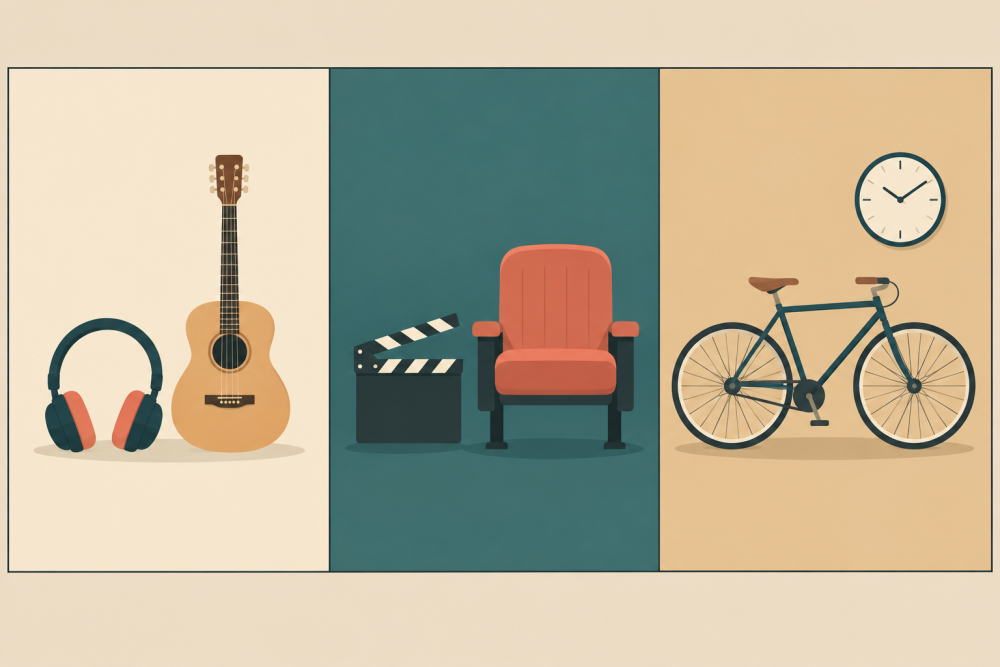
If you have looked for how to talk about music in English, you have probably found long lists of genre names. Genre labels are useful when you are searching for songs, but on their own they end conversations, because the other person has nothing to reply except Me too.
A more reliable pattern is to describe what you notice and how it affects you, instead of judging whether the music is good. Three sentence shapes cover most situations.
Say what you have been listening to: I have been listening to a lot of jazz lately, mostly piano trios.
Say what one thing in it sounds like, in plain words: The singer's voice is very low and calm, so I usually put it on while I am cooking.
Say honestly what you do not know: I do not remember the name of the band, but the song has a long guitar intro.
If a word is missing, describe the sound instead of stopping: It is quite fast and there are a lot of drums in it. Nobody expects you to name a genre correctly, and a description you can defend is more useful than a label you are unsure of.
Then hand the topic back with a question that is easy to answer, such as What have you been listening to recently?
Films, Series and One Phrase Worth Knowing
Films and series are easier than music, because a plot gives you something concrete to describe. Use the same three-part shape: what you watched, one detail, and your reaction.
I watched a French film last weekend. It was slow at the start, but the ending stayed with me for days.
When someone is about to watch something, English speakers often use a short fixed phrase: Enjoy the movie! You will also hear Enjoy the film!, and both are understood everywhere, so the safest choice is the version the other person just used.
One note on the verb. Cambridge Dictionary defines enjoy as getting pleasure from something and shows it with a noun (I really enjoyed that movie) or with an -ing form (I enjoy meeting people). That is why Enjoy the movie! works as a wish before a film starts, and why I enjoyed the movie describes it afterwards.
Questions That Keep a Hobby Conversation Going
A hobby answer is only half of an exchange. These four questions cost you very little to ask.
How did you get into it? works for any activity and usually produces a story rather than a one-word reply.
Do you do it all year round? fits outdoor hobbies, and the answer tends to mention weather or season.
Is it expensive to start? is practical, and people rarely mind answering it.
Who do you usually go with? turns a solitary answer into a social one.
Ask one of these, then listen for the detail you can build on. A conversation about hobbies usually continues because of the second question, not the first answer.
A Ten-Minute Routine You Can Run Alone
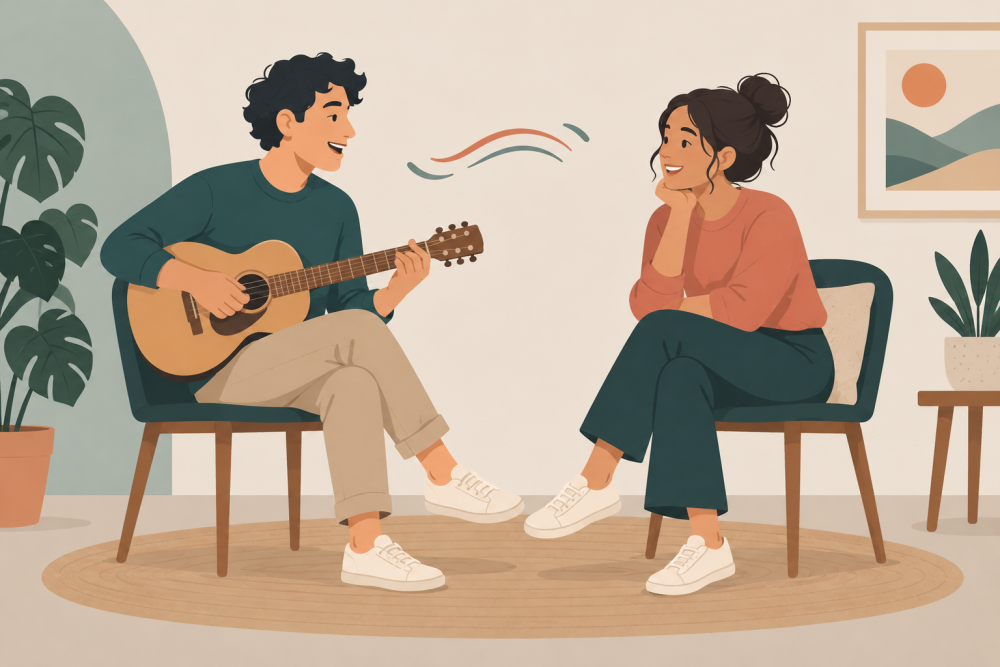
Speaking about hobbies is a rehearsable skill, and ten minutes a day is enough to change how you answer.
Start with three minutes of recording. Answer What do you do in your free time? twice using the three-line shape, then listen once and write down only the words that were unclear.
Spend the next four minutes on listening and repeating. British Council LearnEnglish publishes free material for different levels, and BBC Learning English publishes free six-minute episodes with transcripts, so you can check any line you did not catch. Repeat one line at a time, copying the rhythm rather than the spelling.
Use the last three minutes to answer the same question again, adding one follow-up question of your own. Practising the question is the part most learners skip, and it is the part that keeps the other person talking.
If your next real conversation is an interview rather than a chat, the same pattern applies with a different subject: English job interview questions and answers covers that version, and Business English speaking practice covers the shorter workplace form of the same skill.
Frequently Asked Questions
How can I practice talking about my hobbies in English?
Choose three hobbies you genuinely have and write a three-line answer for each: what you do and how often, one concrete detail, then one reason or small problem. Record all three, listen once, and shorten any sentence you stumbled over. Three real answers are more useful than fifty memorised hobby nouns, because a listener will ask about the details you gave.
how to talk about your free time and hobbies in english spoken english lesson
A useful spoken English lesson on this topic has four parts: a model answer you can hear, the follow-up questions a listener would ask, one round where you answer out loud without reading, and feedback on the words that were unclear. You can run those four parts alone by recording an answer, playing a short native clip, and answering again.
how to say enjoy the movie in english
Say Enjoy the movie! before the film starts, or Enjoy the film! if you prefer the wording the other person used. Both are wishes about an experience that has not finished yet, so nothing needs to follow them. To talk about it afterwards, change the verb form and the subject: I really enjoyed the movie. or Did you enjoy the film?
how to talk about music in english
Describe rather than judge. Name what you have been listening to, give one plain detail about the sound, and say what you do not know instead of guessing: The singer's voice is very low and calm, so I usually put it on while I am cooking. Genre names help you find songs, but a described detail gives the other person something to reply to.
how to talk about hobbies in english
Use three short sentences in a fixed order: the activity and how often, one concrete detail, then one reason or small problem. Then stop and let the other person ask. This works because it gives them something specific to follow up on, and because the pattern is short enough to remember while you are speaking.
how to talk about my hobbies in english
Start from the hobbies you actually do rather than the ones that sound interesting, because you will need a second sentence about each of them. Write a three-line answer for three hobbies, and for each answer prepare one follow-up question you could ask in return. Three ready answers remove most of the hesitation this topic causes.