
How to Improve IELTS Speaking at Home: Tips and Strategies
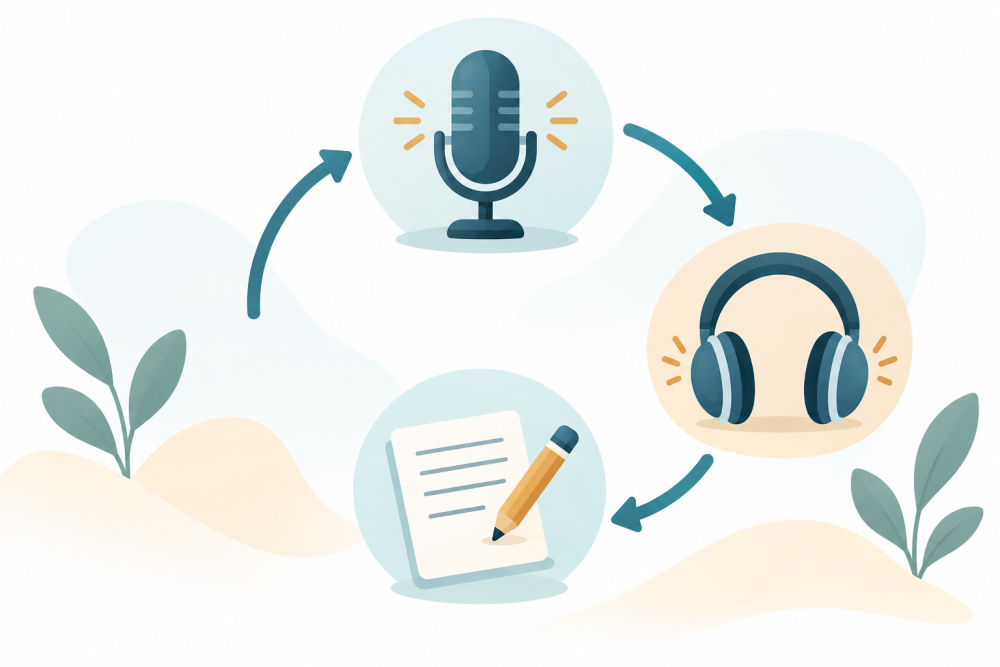
A short routine beats a long one: record an answer, listen once, fix one specific thing, repeat. This guide turns the four IELTS Speaking criteria into IELTS speaking practice free of guesswork.


On this page
Why Home Practice Works for IELTS Speaking
IELTS Speaking is a recorded, face-to-face interview with a certificated examiner. It lasts 11–14 minutes and has three parts: a short introduction and interview, a two-minute individual long turn, and a discussion that moves towards more abstract questions (IELTS Academic Speaking test format, accessed 26 October 2026).
Nothing in that format requires a classroom. The examiner scores four criteria from what you say, so a quiet room, a phone recorder and thirty focused minutes can be a legitimate rehearsal. The catch is that most people practise the wrong thing: they read model answers instead of producing speech, and they never listen back.
The Four Criteria You Are Scored On
Every IELTS Speaking score comes from four criteria, and each one is scored separately before the examiner decides your band (IELTS Speaking key assessment criteria, accessed 26 October 2026). Home practice should target all four, not only the one you find easiest.
| Criterion | What the examiner listens for | A home exercise that targets it |
|---|---|---|
| Fluency and coherence | Continuous speech at a normal rate, ideas in a logical order, linking words used appropriately | Record one two-minute Part 2 answer with no notes, then count your long pauses |
| Lexical resource | Range and precision of vocabulary, and the ability to paraphrase when a word is missing | Re-tell the same story twice, replacing five words the second time |
| Grammatical range and accuracy | A mix of simple and complex sentences, with few errors that affect meaning | Re-record one answer and add three subordinate clauses on purpose |
| Pronunciation | Speech that a listener can follow without much effort, with stress and intonation used to carry meaning | Shadow thirty seconds of a recording, then compare it with your own attempt |
A Weekly At-Home Routine
A short routine that you repeat beats a long session you abandon. This one fits five days of about thirty minutes:
- Day 1: record a full Part 2 long turn. One minute of notes, two minutes of speech, no stopping.
- Day 2: listen to the recording once for meaning, then once for one specific problem you can name, such as repeated fillers.
- Day 3: re-tell the same content without the recording, deliberately paraphrasing two or three ideas.
- Day 4: answer six Part 3 questions aloud, aiming for answers that give a reason and an example.
- Day 5: run a timed three-part session, then write down one target for next week.
If you want IELTS speaking practice free of a fixed class timetable, keep the order fixed and change only the questions. Keeping one dull habit is the point: the routine is what makes progress visible.

What to Do With a Recording Once You Have It
Listening back is uncomfortable, which is why it works. Choose exactly one thing to fix per session, and use the same repair phrases until they are automatic. These are examples you can adapt, not scripts to memorise:
- Opening a long turn:
I'd like to talk about my morning routine, which changed a lot last year. - Restarting after a stumble:
Sorry, let me start that again. - Buying a moment to think:
That's an interesting question, and I've never thought about it that way. - Paraphrasing a missing word:
It's a kind of small electric device you clip to your bag.
Record yourself saying each repair phrase three times out loud. A phrase you have spoken is available under pressure; a phrase you have only read usually is not.
Practice Material and Feedback You Can Trust
You need two things from practice material: questions that resemble the real test, and feedback that names a criterion instead of saying "good job". HiBay's IELTS mode offers practice with Part 1, Part 2 and Part 3 questions, plus feedback on pronunciation, grammar and vocabulary, according to its App Store description (accessed 26 October 2026). It is practice software, not an examiner: treat every score as an indication of what to fix next, never as a predicted official band.
Useful companions on this site:
- IELTS Speaking practice with AI: mock questions and instant feedback
- Record, review and repeat: a mock test guide
- Part 1 questions and answers
- Part 2 cue cards with sample answers
FAQ
How can I practice IELTS Speaking at home?
Practise by producing speech out loud under test-like conditions, because that is the only way the four criteria can be assessed. Set the same structure as the real interview: a short introduction, a one-minute preparation for a two-minute long turn, then a discussion, with a timer running.
Then listen to the recording and name one problem in the language of the criteria, such as "I lost coherence after forty seconds" rather than "I was bad". Repeat the same question tomorrow with one deliberate change, and keep both recordings so you can compare them a week later.
How long does it take to improve IELTS Speaking?
Realistic progress depends on how often you speak and whether you review, not on the calendar. Learners who record and review three or four times a week usually notice a specific, nameable change within a few weeks, for example fewer mid-sentence stops or a wider range of linking phrases.
A change large enough to move a band usually takes longer, because examiners rate your average performance across four criteria rather than your best answer. Two useful rules: judge progress by recordings, not by feelings, and change one habit at a time so you can tell what caused the improvement.
Can I practise IELTS Speaking without a teacher?
Yes, for the parts of practice that depend on repetition: fluency, timing, paraphrasing and pronunciation are all measurable from your own recordings. A timer and one specific target per session are enough to run a productive week on your own.
A teacher adds value when you need a second opinion on something you cannot hear in your own speech, or when you want your grammar corrected at a level you cannot judge yourself. Use software feedback for everyday repetition, and save human attention for the questions you cannot answer on your own.
Record One Answer Today
You do not need a new course to start. Choose one Part 2 topic, set a two-minute timer, record the answer on your phone and listen to it once. That single loop is the whole method, and it is the one you can repeat tomorrow.
If you want questions and criterion-based feedback in the same place, practise IELTS Speaking with AI and keep your recordings in a dated folder so progress is something you can hear.