
What to Say in English When You Did Not Catch What Someone Said
A repair ladder for the moment you lose the thread: echo what you heard, ask for one word, paraphrase back. English conversation practice free of a script, with twelve lines and a drill.


On this page
You are four sentences into a story about a colleague's weekend when one word goes missing. The word was the point. You can let the story run on, or stop the storyteller and ask. Most learners pick a third option: they say Sorry?, get the same sentence at the same speed, then say Sorry? again.
This guide is about the second option: a ladder of five moves, twelve lines you can use tonight, and one drill for English conversation practice free of a partner.
Why a third "sorry" ends the conversation
When you say Sorry?, you ask for the whole sentence again. That is fair once. The second time, the speaker slows down and repeats it word for word. By the third time, many people stop repeating and summarize, or say Never mind, which closes the topic.
Two things go wrong. A full repeat throws away what you already understood, so the speaker rebuilds the whole sentence instead of filling one hole. And a bare Sorry? says nothing about which part failed, so they guess: louder, slower, other words, often missing the same word again.
Conversation analysts call these moments repair. In a 1977 paper in Language, Schegloff, Jefferson and Sacks described repair as the machinery conversation uses for problems in speaking, hearing and understanding, and showed that speakers prefer to repair their own talk. The practical version: the less work you hand back, the more willing they are to pick it up.
The repair ladder: five moves from cheapest to most disruptive
Each rung asks the other person for less speech, so each costs them less patience.
| Rung | What you say | What it asks for | Best moment |
|---|---|---|---|
| 1 | Sorry? | the whole turn | a quiet room, one soft word |
| 2 | You said the meeting moved to...? | the last few words | you heard everything except the end |
| 3 | Sorry, the what? | one word | you know where the hole is |
| 4 | So the deadline is Friday, not Monday? | a yes or a no | you caught the meaning, not the detail |
| 5 | I'm losing the thread - can we take that part again? | a short chunk, slower | noise, fatigue, an unfamiliar accent |
Most learners live on rung one and jump to rung five. The middle rungs are where conversations survive: specific enough to answer in one turn, small enough that nobody feels blamed.
Twelve repair lines, ordered from least to most disruptive
| # | Line | It asks for | Cost |
|---|---|---|---|
| 1 | Sorry, I missed that. | a repeat | one sentence |
| 2 | Sorry, I didn't quite catch that. | a softer repeat | one sentence |
| 3 | Could you say that again? | a repeat | one sentence |
| 4 | You said the train leaves at...? | the sentence end | a few words |
| 5 | Sorry, the what? | one word | one word |
| 6 | Which one did you mean? | a choice | a choice |
| 7 | Was that Tuesday or Thursday? | one of two | one word |
| 8 | Could you spell that? | letters | a name, slowly |
| 9 | So the office is closed until Monday? | yes or no | one word |
| 10 | Can I check - you want the report by Friday? | yes or no | one word |
| 11 | I'm not getting this - the last part again? | a chunk, slower | a restart |
| 12 | Can you send that in a message? | a written copy | a message later |
The first six suit noise and speed, seven to ten a missing word or name, the last two a stalled exchange. The order is by speech handed back, not politeness: Sorry, the what? sounds blunt on paper but beats a third Sorry? in a noisy room.
The paraphrase check: make them confirm instead of repeat
Rung four is the move most learners never try. You say back what you think you heard, as a statement with a rising end, and the speaker only has to confirm or correct it.
It costs them one word. A repeat costs the whole sentence: find the start, rebuild the clause, say it again while you watch. A paraphrase costs Yes or No, and a no usually arrives with the missing piece attached: No, Thursday - the training is Thursday, the meeting was Tuesday.
It is also more accurate, because the same meaning in a different shape is easier to decode than the sounds that just failed.
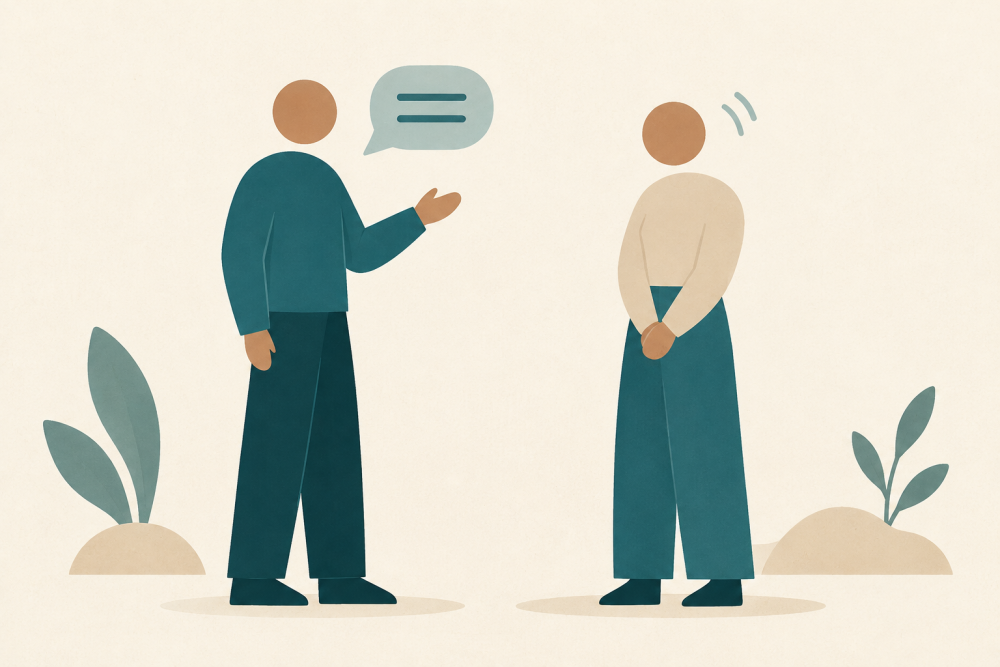
Two rules. Guess the meaning, not the words, or you earn a slower repeat of the same problem. And leave real space for the answer: a question-shaped statement invites correction, while a confident summary invites a nod.
Timing the interruption so it does not derail the sentence
Where you cut in matters as much as what you say. Interrupt at a boundary - the end of a clause, after a name, after a number - and the speaker can repeat the smallest useful unit. Interrupt mid-word and they lose their place too.
Three habits help. Signal first: Hang on - or Sorry, quick check -. Apologise once, because Sorry, sorry, so sorry turns the moment into a discussion of your embarrassment. Then return to the story with something that shows you were listening: Right, so that was after the move?
One repair per unclear item: stack two questions and people answer the easier one.
When to let a detail go
Not every missing word deserves a stop; three questions sort them.
- Does an action depend on it? Times, prices, names, addresses and instructions do. An adjective in an anecdote usually does not.
- Will the next sentence resolve it? Speakers often explain their own term a line later.
- Can you check it at a natural boundary? Then let it pass for now.
A stopped conversation costs more than a missing adjective, but a wrong number or a reversed instruction costs more than a stop. The test is what changes if you miss it, not how much you want to know.
A ten-line dialogue with three unclear words
An exchange in a cafe, written the way it sounds. Three items are unclear; the last column is the repair and what it produced.
| Turn | Line | Unclear | Repair and result |
|---|---|---|---|
| 1 | Did you get the thing from what's-his-name? | the person | wait one turn |
| 2 | From the man at the print shop? | nothing | paraphrase confirmed: Yes, Marco. |
| 3 | Delivery is the fourteenth, invoice to finance. | the date | Sorry, the date again? then The fourteenth. |
| 4 | He needs the proof signed before Thursday. | nothing | none |
| 5 | Otherwise it slips to the week after. | slips | So it moves a week? then Exactly. |
| 6 | Send it to him, the address is on the sheet. | which sheet | Which sheet? then The shared folder. |
| 7 | His email is the one at the bottom. | which email | So I reply to his last message? then Yes. |
| 8 | And copy in the studio. | studio | Sorry, copy who? then The design studio. |
| 9 | Can you do that today? | nothing | none |
| 10 | So, reply to Marco and sign the proof by Thursday. | nothing | paraphrase accepted |

Three unclear items, three repairs, and a confirmed task at the end. The first item was never repaired: the name arrived in turn two, which is why waiting one turn belongs on the ladder.
English conversation practice free of a partner
You do not need a partner, only a recording you cannot control.
- Record ninety seconds of a podcast or a meeting replay at normal speed, with some background noise.
- Play it once. When an item goes missing, write the timestamp and the rung you would use.
- Play it again and say the repair out loud before the recording moves on. One repair per unclear item, not three.
- Count items missed, repairs used, and items resolved in one turn. The third number is the one that matters.
- Run the same dialogue with a partner or an AI chat and see whether the repairs survive a live reply.
HiBay's AI chat is built for that last step: hold a conversation at speed, interrupt it, ask for a word again, then get feedback on your speaking against IELTS and TOEIC criteria. It shows which repairs you use under pressure; it is not a promise that you will stop missing words.
Never repeat the same request twice in a row: if rung two fails, move to rung four or five. A repeated failed move is what makes a conversation feel like an interrogation.
Frequently asked questions
Is it rude to ask someone to repeat themselves in English?
Not by itself. Asking once is ordinary. Asking the same person to repeat the same sentence three times without changing the request is what wears people down. Be specific and short: Sorry, I didn't catch the name. That names the problem, so the speaker knows what to fix, and it takes one turn instead of three.
In most English-speaking workplaces a quick clarification reads as attention, not ignorance; mumbling an answer you did not understand is harder to forgive.
What do I say if I still do not understand?
Change the question, not the volume. If a repeat failed, ask about the part: Sorry, what does that word mean? or Can you say the last part another way? Meaning is easier to answer than the same sounds again.
If the words are clear but the idea is not, say what you have and stop: I've got the deadline, but not who signs it. That gives the speaker a place to start. If it matters, ask for it in writing and read at your own speed.