
Common English Pronunciation Mistakes: A Practical Checking Guide
Check a confusing word, compare a dictionary model, and try the sound in a useful sentence. Use recordings and listener feedback to choose a manageable practice target.


On this page
Common English pronunciation mistakes are easier to investigate when you can name the word or phrase that was unclear. A request to repeat something may involve a sound, stress, pace, background noise, or missing context. It does not identify the cause by itself.
Use the checks below to choose a specific practice target. Recorded dictionary models are useful references, while valid English accents can differ. The aim is to communicate your meaning clearly, not to erase your identity or meet a promised improvement deadline.
Listen Before Guessing from Spelling
Look up an unfamiliar word before deciding how its letters should sound. For example, the shared letter pattern in through and rough does not produce the same pronunciation. Merriam-Webster provides separate dictionary entries for these words, including a separate entry for the second word.
Listen to a model, try the word, and then place it in a sentence you would use. If the dictionary offers more than one pronunciation, note which model you are comparing. A difference from one recording is a reason to investigate, not automatic proof that your accent is wrong.
Check One Vowel Contrast
Compare ship and sheep. Their spellings and vowel sounds differ, so look up both rather than treating the second spelling as an instruction to stretch the first word. Use the ship entry and sheep entry as reference points.
For an original practice example, record I said ship. and I said sheep. Listen back alongside the models. If you cannot hear a distinction yet, ask a teacher or another knowledgeable listener what to listen for. Repeating the pair without knowing what to change may not resolve the problem.
Keep Meaningful Endings in the Sentence
Word endings can carry grammatical information. Compare walk with walked, or bag with bags. In a sentence, check whether the ending needed for your intended tense or number is present. For example, practice I worked there last year. or She wants two tickets. These are learning examples, not facts about your life.
Ask a listener what they heard, then compare it with what you meant. Sounds can link or change in connected speech; you do not need to force every consonant into a separate, heavily released sound. For help distinguishing a grammar choice from a pronunciation target, see our speaking and grammar guide.
Check Stress for Each Word Form
When learning a longer word, check its syllables and stress as well as its individual sounds. Related words do not necessarily keep the same pattern. Look up the particular form you want to use, listen to its recording, and try it in context rather than relying on spelling alone.
Phonemic symbols are one way to keep a note of sounds. The British Council's Sounds Right resource explains its sound chart and example-word audio. You can consult the resource without copying its chart into your own materials. Audio, a useful example, and a note about stress can also support an exercise.
Put the Word Back into a Phrase
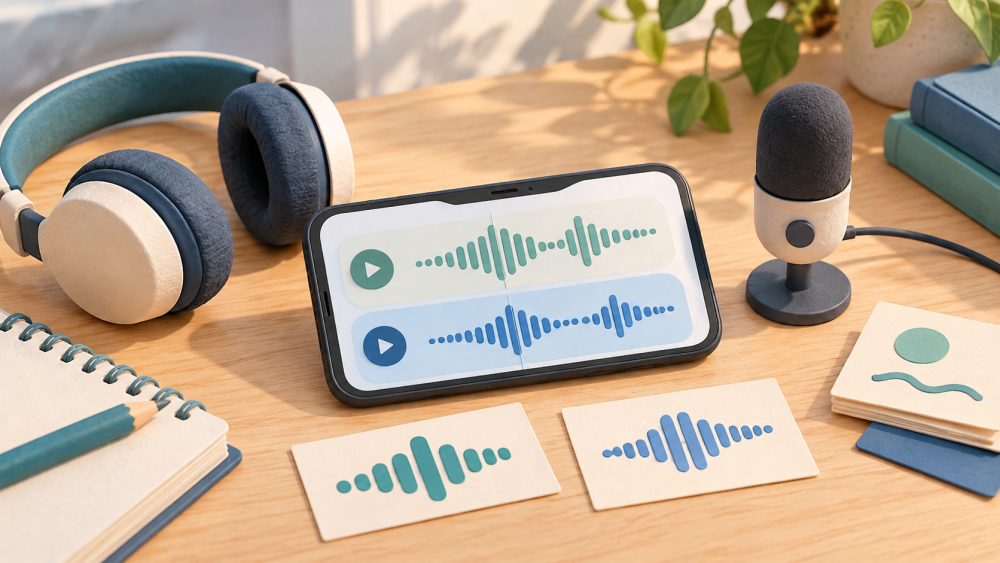
After checking an isolated word, use it in a short phrase you understand. Listen for where the speaker groups words and which words receive emphasis. You can pause a short recording and repeat a section; there is no required delay or number of repetitions for this exercise.
For example, try Could you help me? in a situation where you need assistance. Then change the request to fit something you actually want to ask. Copying a recording can help you examine its delivery, but you also need opportunities to express your own meaning.
Review a Target Without Treating a Transcript as a Verdict
A speech-to-text result is a clue to inspect. A wrong word may involve your delivery, the recording conditions, or the recognizer; a correct transcript does not prove every sound was clear. Listen to the audio and, when possible, ask a person what they understood before deciding what to change.
Choose a word or phrase, save a recording, and write down the change you want to try. Return to the same task later and compare what you can hear. Adjust the amount of practice to your needs; no fixed number of minutes or days guarantees that a sound will become reliable.
Frequently Asked Questions
How can I check my English pronunciation online?
Compare a recording of your speech with a reliable audio model and identify a specific word or phrase to review. An automatic transcript or score can suggest something to inspect, but it is not a listener's verdict. If the issue remains unclear, ask a teacher or another knowledgeable listener for an explanation.
Do I need to remove my accent to speak clearly?
You can work on intelligibility while keeping features of your accent. Begin with a word, ending, or stress pattern that affected a real exchange, and check what the listener understood. A difference from one dictionary recording does not by itself establish an error; English has pronunciation variation.
Which English sounds should I practice first?
Start with a specific word or phrase that was misunderstood or that you cannot yet compare confidently with a model. Check whether the difficulty involves a vowel, consonant, ending, stress, or the surrounding phrase. A list of supposed problems for speakers of your first language cannot identify your individual needs.
How long does it take to improve one pronunciation target?
There is no single timeline that applies to every learner or target. Keep a recording and compare a later attempt on the same task, then decide what still needs attention. A sound produced in isolation may still need work in a phrase or conversation; a short practice streak is not proof of a permanent change.
Do I need to learn phonetic symbols?
Phonetic symbols can help you record a sound or compare dictionary entries, but you can begin an exercise by listening carefully to a model. Learn a symbol when it helps resolve a specific question. Check the notation used by your reference rather than assuming every dictionary represents pronunciation in the same way.
For app-based practice, Hibay's public app description describes pronunciation feedback and conversation reports. Inspect a suggestion against your recording and use it to choose a question to investigate. Begin with a phrase you expect to use, then check whether the revised version communicates what you mean.